7.7 🍺above average

“A huge symphonic stink,” is how the writer Tom Wolfe described Brooklyn’s Gowanus Canal. The 1.8-mile waterway, once the busiest industrial and commercial canal in the U.S., was by Wolfe’s time one of the most toxic bodies of water on the planet, its bottom coated by a 10-foot layer of sludge known as “black mayonnaise,” a noxious mix of industrial waste, coal tar, heavy metals, and raw sewage accumulated over a century of abuse. Despite millions in Superfund money, it still stinks near low-lying areas, former industrial sites, and after heavy rains.

When I visited Gowanus in the spring of 2016, I was greeted, instead, by the sweet, cereal-like aroma of mashing grains emanating from the brewhouse of the Other Half Brewing Co. The two-year old facility, shoe-horned into a former auto repair shop, crouched beneath the Brooklyn-Queens Expressway, across the street from a scrap-iron yard and barely a block from the infamous canal. Graffiti sprawled across the brewery’s façade, and its name and logo were painted in small letters on the wire-mesh window of the customer entrance.

There was no bar, per se, just a serving area behind which an employee handed out glasses of draft beer. The cash register was tucked into the same alcove where customers’ car keys once hung on small hooks. Once served, you could sit at one of three rough-hewn tables or lean against waist-high shelves that extended along the remaining three walls. The clientele was as chill as the gray cat lounging atop one of the tables.

We were lucky to arrive too late for lunch and too early for happy hour. We suffered the shortest of waits for drinks and none of the usual NY cheek-to-jowl crowding on a Wednesday afternoon. By the weekend, a line would snake around the block for the weekly can release.

In its first year, Other Half brewed mostly West Coast IPAs and farmhouse saisons. By year two it began to focus more on hazies; and now in its third year, its name was nearly synonymous with the hazy New England-style of IPA that everyone wanted to drink in 2016. All but two of the 11 beers on tap were some kind of hoppy beer: 2 pale ales, 2 IPAs, 2 double/imperial IPAs, a black IPA, a Brett IPA, and a farmhouse pale ale. (The two not-hoppy beers were an 11% imperial stout and a 12% wheatwine.)

I had just tasted my first hazy IPAs (Edward and Susan from Hill Farmstead) the previous day at the Blind Tiger Ale House in the West Village. As good as they were, these Other Half beers impressed me even more. Perhaps it was the vivid freshness of a brewery tap or the no-frills authenticity of the tap room or the friendly welcoming vibe. I’ve tasted thousands of hazies since then, but those first few pints will always be the most memorable.
Other Half’s origins trace back to a serendipitous visit with in-laws. In 2007, brewer Sam Richardson and his wife traveled from Portland, Oregon, to New York to visit her parents. A Portland native, Richardson had studied fermentation science at Oregon State, gotten a job with a Seattle brewpub chain, then returned to Portland where he had been working with craft pioneer Pyramid Brewing for the past three years. During the visit, he discovered that Greenpoint Beer Works in Brooklyn had just posted an opening for head brewer. After making thousands of barrels of Pyramid Hefeweizen, Richardson was looking for something “more entertaining.” He applied for the job, got hired, and began a six-year stint contract-brewing for many of New York’s early craft brewers, such as Sixpoint, Southampton, and Coney Island.
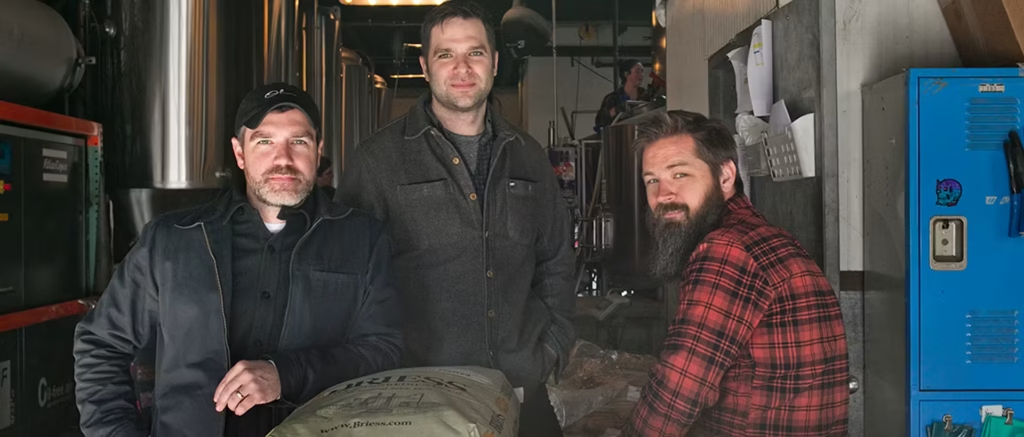
While at Greenpoint, Richardson met former line cook turned brewer Matt Monahan and his fellow DC buddy Andrew Burman, who also had a culinary background. Together they staged a pop-up restaurant event featuring food from Monahan and Burman and beer brewed by Richardson and Monahan. When customers saved their greatest enthusiasm for Richardson’s West Coast IPAs, the trio knew they were on to something. They began to focus on just the beer. Called themselves the Other Half.
High rent, steep labor costs, and excessive licensing and zoning restrictions had made New York City a brewery desert for much of the craft brewing renaissance. It took three months to build out a rudimentary brewery but 18 months to navigate NYC bureaucracy, nearly going out of business twice, according to Monahan. On the day they finally received their flow meter—which measures taxable output—on January 31, 2014, they were so eager to get going that they fired up the brewery at 8 pm and finished their first batch at 4 am.
A wealth of contacts in New York’s restaurant and bar scene helped get their beer out to a public that was thirsting for the kind of West Coast IPAs that Other Half was so adept at brewing. But the turning point came a few months later when New York legalized direct-to-consumer sales. The three partners carved out a 100 square feet of space for a tap room and began selling 16-ounce cans from it. These were the early days of line culture, and no one seemed to be generating longer lines and a greater buzz than Other Half. The New York Times reported some fans waiting up to 11 hours for an anniversary edition IPA.
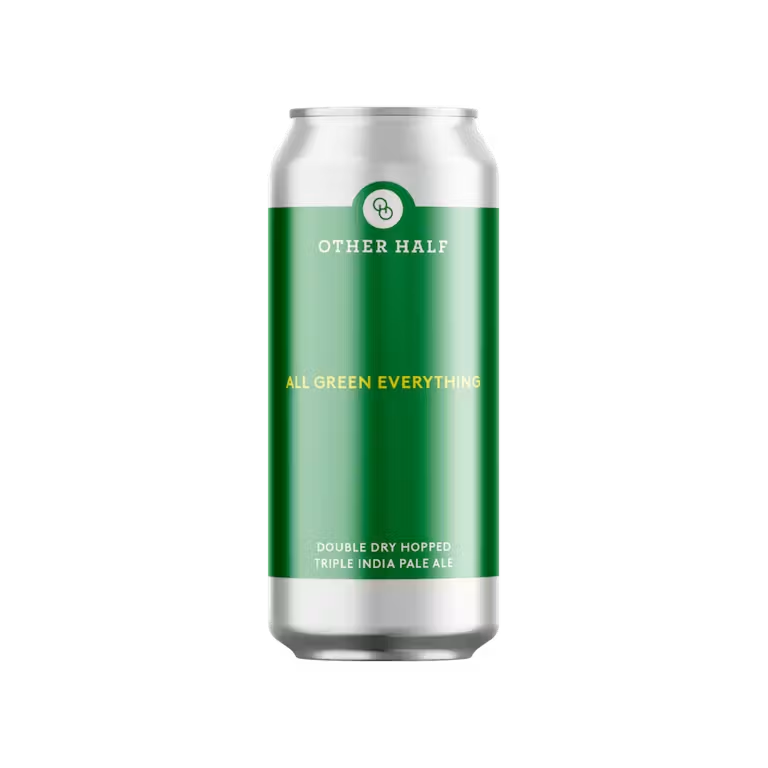
Their earliest output comprised mostly the West Coast IPAs that Richardson had been brewing since his Oregon days and a smattering of saisons and other styles. In spring 2014, Other Half released its first New England-style IPA (All Green Everything)—and the first brewed in New York. By 2016, they were leaning heavily into hazies, with as much as 85% of production dedicated to IPAs.

In many ways, Richardson was the right person in the right place at the right time. He had been brewing Pacific Northwest IPAs for more than a decade and was as knowledgeable as anyone about infusing hop flavor into beer. By 2013, he and his partners had a keen sense of where the industry was headed and were among the very first breweries south of New England to produce consistent, high-quality NEIPAs. As a team, Other Half possessed the entrepreneurial skills to optimize the new taphouse business model for selling craft beer and the commitment and drive to stay atop the crest of the wave for more than a decade and counting.
Monahan assumed the role of CEO and Burman COO. Richardson focused on designing the beers and sourcing ingredients. He also named the beers and supervised the artwork, establishing a clean design style and a cohesive brand identity—quite a challenge when you’re producing a couple hundred different versions a year of the same beer style. For example, straightforward text on a brightly colored background is used to distinguish the “All (hop strain) Everything” series of single-hop beers or the “More (hop) Than All (hop)” triple IPAs. Similarly, the “Hop Duos!” beers all have a similar look. Beers in the “Juice” series all feature a recurring cartoon character. The brewery is probably best-known for the “Munchies” beers, which feature a simple graphic of some cheese, vegetable, or snack food repeated against a colored background. The beers’ names are relatively simple and fun (Whiz), humorous non sequitars (Mylar Bags), whimsical (Shroomies), or often have include the word green (Green Street and Street Green).
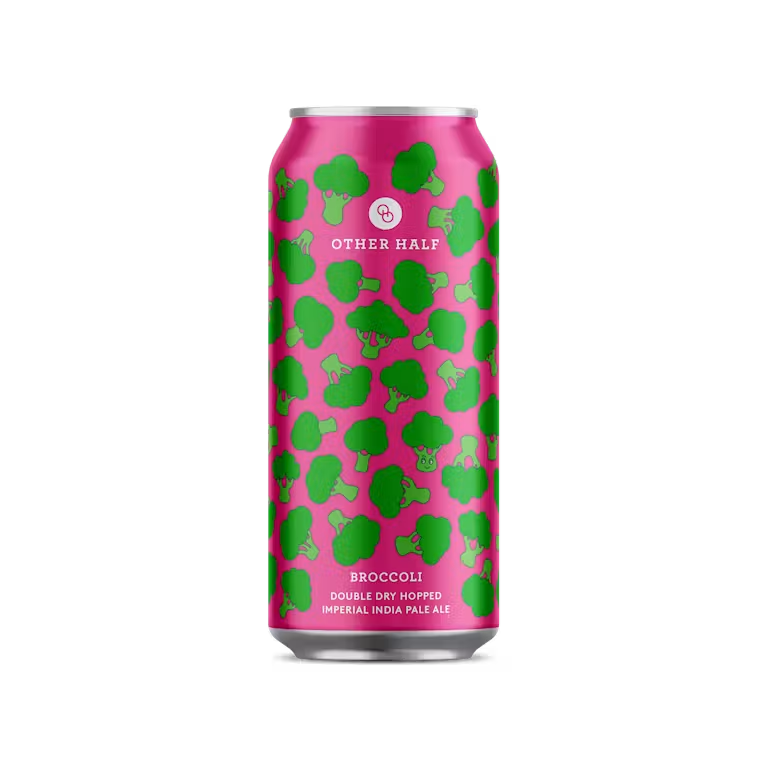
In those early years of the haze craze, traditional dry-hopping gave way to “double-dry-hopping,” as brewers competed to see how much hop flavor they could pack into an IPA. While the process was widespread, no one incorporated it into their branding more effectively than Other Half, as fans began to seek out “DDH” versions of their favorite OH IPAs. From 2016 through the next several years, the brewery churned out at least 220 DDH-branded beers (based on BeerAdvocate reviews).
It was around this time that Punch magazine crowned Other Half the “official beer of Wall Street.” Writer Aaron Goldfarb reported on a Gatsby-esque Hamptons party in which most of the men were drinking Other Half double IPAs procured by line-sitters earning $20 and hour from companies like TaskRabbit and Same Ole Line Dudes. “A considerable portion of our clients are in financial services,” Robert Samuel of Line Dudes told Goldfarb. Michael Pomranz from Food & Wine noted that “When a type-A guy says, ‘This beer is the best,’ and then you drink it and the hoppiness is just through the roof, what makes it ‘the best’ is easily quantifiable. There’s no need to parse any details, it’s just time to fist bump.”
Other Half continued their pursuit of ever bolder, brighter IPA flavors by incorporating new hop products into their brewing process. In 2017, they began brewing with Yakima Chief’s lupulin-enriched Cryo hop pellets, which contain nearly twice the hop oil of standard T-90 pellets (90% leafy bracts, 10% pure hop oil). Not only do they boost hop flavor, but by reducing the percentage of vegetal matter, they increase yields by 5–10 percent, keeping a lid on costs.
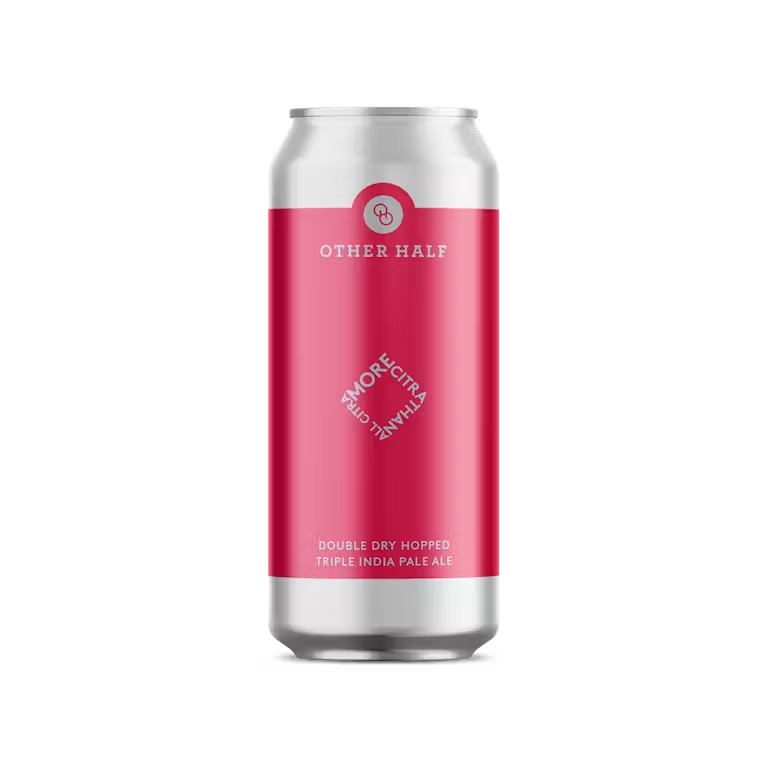
A year later, the brewery began experimenting with Incognito, a sticky, liquid hop oil extract from hop supplier John I. Haas that can be added directly to the whirlpool. Eventually Richardson arrived at a combination of standard T-90 hop pellets, Cryo pellets, and Incognito that had the flavor impact equivalent of 15 pounds of hops per barrel—but without the astringency and resin burn that would result from such a mega dose. Other Half coined the term “high dosage hop charge” (HDHC) to describe IPAs made with this process and debuted the new product line in 2019 with HDHC More Citra Than All Citra. While other brewers were doing similar things with new hop extracts, the HDHC branding helped position Other Half as the industry leader.
Other Half has not coined any acronyms for astute hop selection, but their consistent use of the phrase “hand-selected hops” suggests how important hop selection is to their beer’s character. Other Half’s hop-purchasing power affords them access to the best lots every harvest. “It all starts with hops selection, and it’s something that we’ve been trying to be as involved with as possible from the get-go,” Richardson told Beer and Brewing in 2019. “We’re more interested in varieties that contribute a unique set of flavors in a way that helps us create new beers that we love.” And while many brewers today dry-hop during active fermentation to promote biotransformation, Richardson feels it “muddles” the character of the hops. “Dry hopping at terminal [gravity] gives you more clarity in the hop profile . . . I want the hops we picked to shine.”

Few breweries have been as prolific as Other Half. At one point, the brewery was churning out over 300 different beers a year. “Don’t test it, just brew it” was their guiding principle. “We’ve never piloted a beer ever,” Monahan once bragged. And yet few breweries have such a sterling reputation for consistency. “We’re not shy about throwing away [dumping] beer,” COO Andrew Burman told Andrew Coplan of Craft Beer Professionals in 2025. I’ve quaffed my share of Other Half IPAs, and I’ve never had one that was less than excellent.

Other Half never does anything halfway. On June 23, 2018, they hosted their first Green City beer festival at Industry City in Brooklyn. The nearly 50 attending breweries comprised a who’s who of American craft brewing plus a number of Green City Worldwide collaborations. In addition to the usual food trucks, guests were treated to live wrestling matches from the New York Wrestling Connection. By 2023, rising costs forced Other Half to scale back the festival to a more manageable event at its original Center Street brewery in Gowanus.
It’s not always about the hops, though. Other Half has established a considerable secondary reputation for its high-gravity pasty stouts. On March 7, 2019, it hosted the first-ever beer festival dedicated to these dessert-like beers. More than 30 breweries participated in the first Pastrytown festival, and yes, there was pro wrestling. Pastrytown, like Other Half’s other festivals, began to scale back in 2023 from large standalone events to smaller in-house brewery celebrations that coincide with “stout box” releases.

The future couldn’t have looked brighter, when on April 25, 2019, Other Half purchased eight acres of land and the chalet-style building that once housed Nedloh Brewing Co. in the Finger Lakes village of Bloomfield, New York. Located about a half hour from Rochester and just minutes from Canandaigua Lake, the new farmhouse-style brewery and beer garden would not only bring fresh OH beer to upstate New York, but also provide a dedicated facility to experiment with spontaneous and mixed-fermentation brewing. Other Half had already tested the waters with special releases of its beers at upstate locations such as Now & Later in Syracuse, the Tap & Mallet in Rochester, and Thin Man Brewing in Buffalo. Like every place Other Half beers were served, demand was off the charts.

And then the pandemic hit. Always ahead of the curve, Other Half organized “All Together,” one of the largest worldwide beer collaborations to benefit workers in the hospitality industry. The brewery contributed the label artwork and base recipe that could be adapted for either a NEIPA or West Coast-style IPA. More than 800 breweries from the U.S. and over 50 countries participated.

But before covid closed everything down, Other Half had signed a lease to build a large production brewery with an annual capacity of 30,000 barrels, in a former tomato canning plant in the Washington, D.C. neighborhood of Ivy City. At the time, this rapidly gentrifying neighborhood was projected to contribute 10,000 potential customers within walking distance of the brewery, according to Burman, who grew up in the DC area. By the time the brewery was completed, post-covid, that number had shrunk to 500. Even still, Other Half-Ivy City more than doubled production capacity, greatly increasing access to fresh OH beers throughout the mid-Atlantic region. Key word: fresh.
More than any other beer style, hazy IPAs suffer the most if not consumed fresh. Consequently, Other Half has established its own distribution network in most of its mid-Atlantic markets. Still, some retailers can be less than conscientious about keeping beer refrigerated and selling it within a reasonable time frame. To ensure greater access to fresh beer—as well as reinforcing brand identity and “building the evolution of the local brewery”—Other Half has embarked on an ambitious expansion of satellite breweries, taphouses, and production sites.

Other Half opened a second 15-barrel small-batch brewery and taproom in Brooklyn in March 2021 adjacent to Domino Park along the East River in Williamsburg. This was followed in October by a taproom in the center of Manhattan at Rockefeller Center. In February 2022, Other Half opened its first brewery and taproom with a kitchen and beer garden, in the Fishtown neighborhood of Philadelphia. Spring of 2024 saw the opening of a second Finger Lakes brewery and taproom—also with a kitchen—overlooking the north end of Canandaigua Lake. Other Half’s most recent addition is a taproom with kitchen and beer garden in downtown Buffalo, which opened at the beginning of 2025.

I visited the Ivy City taproom during the historic deep freeze of early February, 2026, which was a shame because the taproom features such an inviting array of outdoor spaces, from a wrap-around covered patio to an airy rooftop deck to a funky concourse situated next to the brewhouse and some rusting rail cars. The indoor drinking area is shaped like a barbell. A long corridor is flanked by the bar and a row of tables which open up at one end into a game room with pinball and eight other arcade attractions. At the other end is an area for merch and to-go beer. There are no stools at the bar; patrons order drinks and carry them back to their tables. Dogs are permitted inside taprooms in DC, but I’ve never seen more canine drinking companions than at this Ivy City location.

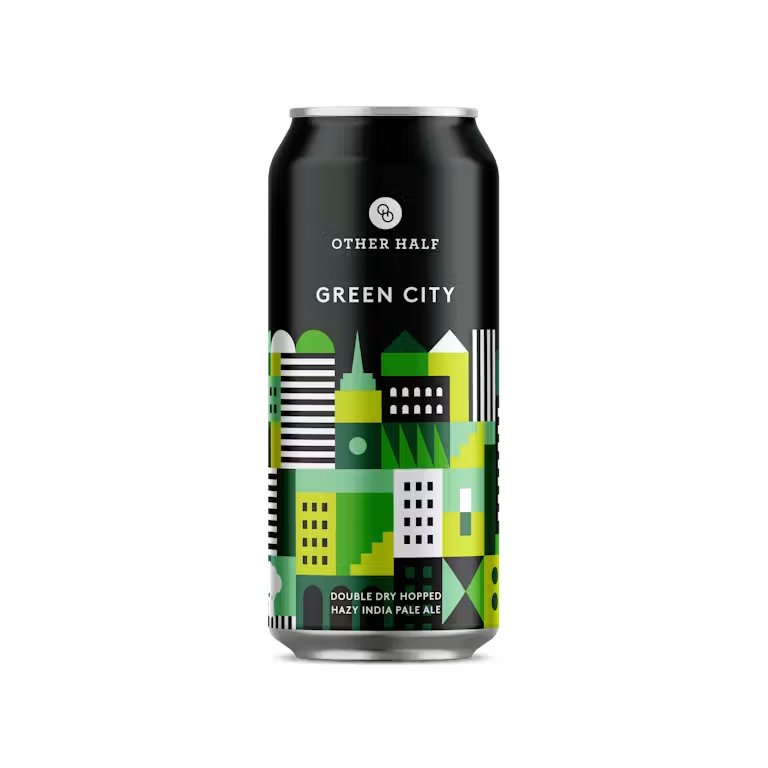
By 2024, the Ivy City facility was producing 16,000 barrels annually, nearly 50% more than the next largest DC brewery, DC Brau. The largest percentage of that output is dedicated to Green City, Other Half’s flagship IPA. (The Center Street brewery in Brooklyn produces the bulk of Broccoli, the flagship imperial IPA.)
I timed my visit to coincide with Other Half’s 12th Anniversary Week. As usual, the brewery produces a new 10% triple IPA (as well as a smaller 6.5% version) to celebrate these yearly milestones, plus recreating fresh versions of the anniversary brews of the previous two years. Here was a rare opportunity to try them side by side.

I confess I was unable to distinguish the aromas of each of these massive IPAs. They all deliver the same robust, slightly sweet blend of tropical and citrus fruits. On the palate, however, they displayed more distinct personalities. The 12th Anniversary edition (essentially a Citra/Mosaic beer with some Nelson and El Dorado accents) tasted the sweetest and was the most citrusy. The preceding year’s offering (featuring a lot of Cryo, Incognito, and liquid terpenes) was full and complex, somewhat piney, and, yes, the dankest of the three. The 10th Anniversary beer (brewed with 10 different hops) was the most intensely tropical tasting and thiol-heavy with noticeable diesel notes from the Riwaka and Simcoe Cryo. My preference though was for the herbal, dank 6.5% version of the 12th Anniversary IPA; I always seem to get more varietal character from the brewery’s lower-ABV hazies.

Also worth tasting was a barrel-aged Bananaversary Stout, intensely roasty and chocolaty, with some contrasting coconut flavor and a nicely balanced banana note; a terpene-dosed Dankest Dads (8%), which easily lived up to its name without going over the top; and DC’s own Ivy City Lager, which was on the malty side, with some nice hop character, and more flavor than I expected for 4.6%.

Other Half knows who it is and how it got here, and their tap list reflects its identity to a tee. On a typical non-anniversary weekend, over two-thirds of the menu consists of hazy IPAs: half of imperial strength, one-third of single strength, plus a token session IPA and one West Coaster. The hop-averse can still choose from a couple of lagers, a dessert stout, a more traditional stout, plus a fruited sour and seltzer.

In pursuit of its goal of “pushing the boundaries of beer and the culture that surrounds it,” Other Half continues to explore new hop flavors, new hop combinations, and new brewing techniques for infusing hop flavor into beer and showcasing the varietal character of an ever-expanding variety of hop strains. “I look at using hops like playing the lottery,” Richardson says. “There’s a pretty large amount of combinations of numbers in lotto, and the amount of combinations of hops is the same.”
For those who say that all hazies taste the same, Other Half offers a convincing rebuttal.

OTHER HALF BREWING – Ivy City (DC)
OPEN
Monday & Tuesday: 4 pm – 8 pm
Wednesday & Thursday: noon – 9 pm
Friday: noon – 10 pm
Saturday: 10 am – 10 pm
Sunday: noon – 8 pm
NUMBER OF TAPS
14
SPECIALTIES
LUKR side-pour tap
AVERAGE ABV
7.3%
OTHER ALCOHOLIC DRINKS
5 varietal wines by the glass
5 cocktails
2 mocktails
2 hot toddies
FOOD
Snacks only: popcorn, chips, charcuterie
PARKING
Parking garage on north side of Okie St. (recommended)
Street parking on Fenwick St. and meters on Okie St. are at your own risk, according to the brewery.